
August 11, 2026
High-precision Core Pull Rivets for High-end Equipment Manufacturing Fields
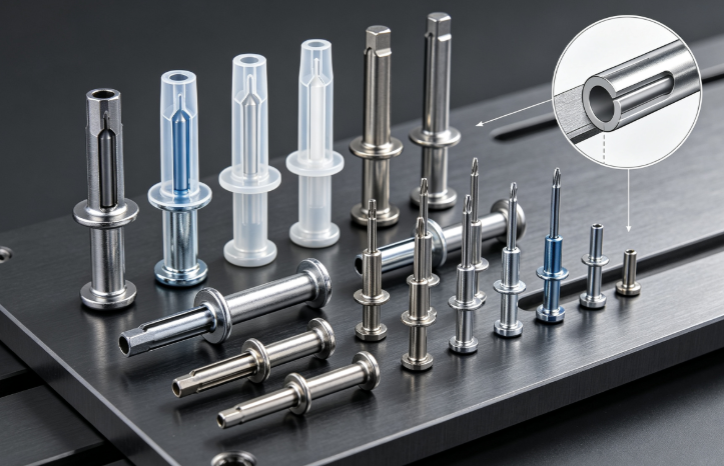
Table of Contents
Definition and Structure of High-Precision Core Pull Rivets
Core Requirements for Core Pull Rivets in High-End Equipment Manufacturing
Application Fields: From Aerospace to New Energy Vehicles
Key Technical Parameters for Precision and Performance
FAQ
1. Definition and Structure of High-Precision Core Pull Rivets
A core pull rivet—commonly known as a blind rivet—is a single-sided mechanical fastener. Its core structure consists of two parts: a hollow tubular body and a slender mandrel that runs through it. During installation, a specialized tool pulls the mandrel, causing the tail end of the rivet body to expand and deform, forming a secure mechanical lock.
What distinguishes a "high-precision" core pull rivet from a standard one includes:
·
Strict dimensional tolerance control for precision assembly applications
·
·
Controlled break surface quality—the mandrel fractures cleanly with no burrs or protrusions
·
·
Higher-grade materials and surface finishes that meet the strength and corrosion resistance requirements of aerospace, new energy vehicles, and other demanding sectors
·
2. Core Requirements for Core Pull Rivets in High-End Equipment Manufacturing
High-end equipment manufacturing imposes requirements on core pull rivets that go far beyond those of general industrial applications. The following dimensions are particularly critical:
2.1 High Strength and Fatigue Performance
In aerospace and automotive manufacturing, fasteners must withstand continuous cyclic loads and vibration. High-strength core pull rivets, through optimized body geometry and material selection, deliver high preload, tensile strength, and fatigue resistance after installation. For example, thread-forming core pull rivets are specifically designed for composite structure assembly and offer significant advantages in preload and fatigue strength over conventional pull-type rivets.
2.2 Corrosion Resistance
High-end equipment often operates in challenging environments—salt spray corrosion in marine equipment, hygrothermal cycling in new energy vehicles, and atmospheric exposure in aerospace. High-precision core pull rivets typically use stainless steel, aluminum alloy, or titanium alloy materials, combined with surface treatments such as zinc plating or passivation, to meet corrosion resistance requirements across different scenarios.
2.3 Vibration Resistance and Loosening Prevention
Under vibration, ordinary fasteners are prone to loosening. High-precision core pull rivets form a permanent connection through expansion locking after installation, inherently providing excellent vibration resistance and loosening prevention. Some rivet products specifically designed for new energy vehicles also integrate IP68 waterproof sealing, capable of withstanding 500KPa air tightness tests and temperature cycling from -40°C to 180°C.
2.4 Material Lightweighting
For new energy vehicles and aerospace applications, fastener weight is also an important design consideration. Aluminum alloy and titanium alloy core pull rivets significantly reduce structural weight while maintaining strength, and offer better electrochemical compatibility with lightweight materials such as carbon fiber and aluminum alloys.
3. Application Fields: From Aerospace to New Energy Vehicles
High-precision core pull rivets play a critical role in multiple high-end equipment manufacturing fields:
Aerospace: Single-sided assembly of aircraft fuselages, wings, and composite structures. Thread-forming core pull rivets are specifically used for composite structures to avoid electrochemical corrosion issues with aluminum/steel fasteners.
New Energy Vehicles: Sealed connections for battery pack enclosures, lightweight structural connections for body-in-white, and high-strength sheet joining. Some domestic high-end rivet manufacturers have already achieved the capability to provide complete customized solutions for new energy vehicles.
Rail Transit: Carriage structure assembly and electrical equipment fixation.
Communications and Electronic Equipment: Enclosures and cabinet assembly for precision electronic devices.
Medical Devices: Permanent connections for precision instruments.
4. Key Technical Parameters for Precision and Performance
Professional high-precision core pull rivet suppliers typically provide quantifiable performance parameters to support selection:
Parameter | Typical Range / Requirement | Description |
Body diameter | φ2.4mm – φ6.4mm | Covers common specifications; custom available |
Grip range | Configured by length | Adapts to different workpiece thicknesses |
Material options | Aluminum alloy, stainless steel, steel, titanium alloy | Matches different environments and strength needs |
Surface treatment | Zinc plating, passivation, non-electrolytic zinc flake coating, etc. | Enhances corrosion resistance |
Tensile/shear strength | Compliant with DIN/GB/JIS/ISO standards | Verified through batch testing |
Mandrel break surface after installation | Smooth, no burrs, no protrusions | A key quality indicator for high-end applications |
5. FAQ
Q: What are the main differences between high-precision core pull rivets and standard core pull rivets?
A: High-precision core pull rivets have tighter controls on dimensional tolerances, mandrel break surface quality, material grades, and surface treatments. For example, a clean, burr-free break surface after installation is a key requirement for high-end applications, while this requirement is typically not emphasized in standard products.
Q: Which core pull rivet material is suitable for aerospace applications?
A: Titanium alloy core pull rivets are widely used in aerospace. Their main advantage lies in better electrochemical compatibility with composite structures, combined with high strength, low density, and excellent fatigue performance.
Q: How can I judge the installation quality of a core pull rivet?
A: Professional installation typically uses automatic riveting equipment with real-time monitoring capabilities that track the number of rivets installed and detect abnormalities. Additionally, the expansion shape of the installed rivet body and the flatness of the mandrel break surface are important visual indicators of installation quality.
Q: Can core pull rivets be used for sealed connections?
A: Some closed-end core pull rivets are designed for applications with certain sealing requirements. Rivet nut products used in new energy vehicle battery packs can also integrate IP68 waterproof sealing and meet 500KPa air tightness test requirements.
Q: How should I select a core pull rivet supplier for high-end equipment?
A: It is recommended to evaluate the supplier's capabilities in: ① experience serving high-end fields such as aerospace and new energy vehicles; ② advanced manufacturing and inspection equipment; ③ ability to provide customized solutions and a complete quality traceability system.
Related articles
May 16, 2026
Multi-component integrated manufacturing of robot joint motor housings: synchronous optimization of flange accuracy, bearing seat coaxiality, and dynamic load
May 16, 2026
Advantages of 7075-T6 aerospace aluminum in optical mounts: strength, lightweight, and anti-reflective collaborative design with black anodization

May 16, 2026
Vibration Suppression and Thermal Stability of Optical Lens Mounts: A Systems Engineering Approach from Material Selection to Structural Damping to Temperature Compensation