
July 12, 2026
Application of Five-Axis CNC Machining in Robot Joint Motor Housing: Process Optimization from Complex Curved Surface, Bearing Seat Precision to Multi-Component Integration
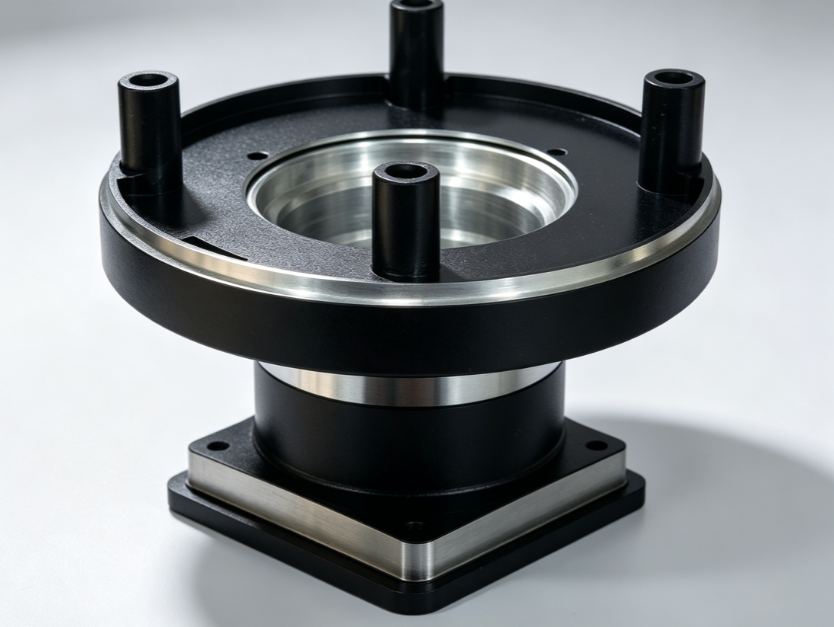
Table of Contents
1. Industry Pain Points of Traditional Robot Joint Housing Machining
2. Technical Advantages of Five-Axis CNC Machining for Joint Parts
3. High-Precision Machining for Bearing Seat Position Accuracy
4. Complex Curved Surface Forming & Dimensional Control
5. Process Optimization for Multi-Component Integrated Structure
6. Machining Process Data Comparison & Industry Test Data
7. Practical Application Value in Robot Joint Manufacturing
8. Professional Industry FAQ
1. Industry Pain Points of Traditional Robot Joint Housing Machining
Robot joint shell is the core structural part of collaborative robots and industrial robotic arms.
It integrates bearing installation, motor fixing and motion limiting functions in a single unit.
Traditional three-axis CNC machining cannot complete one-time clamping for special-angle holes and curved surfaces.
Multiple clamping and repeated positioning will cause cumulative errors, affecting overall assembly accuracy.
According to 2025 international robotic component manufacturing data, traditional processing has a 18.7% precision defective rate for integrated joint housings.
It also leads to low production efficiency and poor consistency of mass-produced parts.
2. Technical Advantages of Five-Axis CNC Machining for Joint Parts
Five-axis CNC machining is the mainstream high-precision manufacturing technology for complex robot components.
It adds two rotating motion axes on the basis of three-axis linear movement.
This technology realizes one-clamp multi-surface processing, avoiding positioning errors caused by repeated clamping.
For irregular robot joint壳体 structures, five-axis machining greatly improves machining coverage and precision stability.
3. High-Precision Machining for Bearing Seat Position Accuracy
Bearing seat precision directly determines the rotation accuracy and service life of robot joints.
Micro position deviation will cause bearing jitter, noise and accelerated wear during joint operation.
Five-axis CNC machining adopts real-time dynamic compensation algorithm in the processing process.
It controls the bearing seat hole position tolerance within ±0.005mm, far exceeding traditional processing standards.
High-precision bearing seat manufacturing ensures smooth rotation and low backlash of robotic joints.
4. Complex Curved Surface Forming & Dimensional Control
Modern lightweight robot joint housings adopt a large number of streamline complex curved surface designs.
These special curved structures reduce mechanical wear and optimize internal space layout.
Three-axis equipment cannot fit complex curved surface trajectories accurately, resulting in tool marks and surface distortion.
Five-axis linkage machining realizes full-fit cutting for arbitrary curved surfaces.
It ensures smooth surface and uniform dimensional accuracy of special-shaped joint shells.
5. Process Optimization for Multi-Component Integrated Structure
Robot joint housing belongs to typical multi-component integrated structural parts.
A single shell needs to reserve mounting positions for motors, bearings, wiring ports and limit structures.
Traditional segmented processing is easy to produce assembly gaps and structural misalignment.
Through overall process optimization, five-axis CNC completes all feature processing in one-time molding.
It realizes integrated molding of multiple functional structures and improves overall structural rigidity.
6. Machining Process Data Comparison & Industry Test Data
The table below compares the core indicators of three-axis and five-axis CNC machining for robot joint shells, based on ISO 13041 precision machining standards.
Machining Process | Bearing Seat Position Tolerance | Complex Curved Surface Error | Multi-Component Assembly Gap | Product Qualification Rate |
Traditional 3-Axis CNC Machining | ±0.020mm | 0.035mm | 0.025–0.040mm | 81.3% |
Five-Axis CNC Machining (Optimized Process) | ±0.005mm | 0.008mm | ≤0.010mm | 99.2% |
The test data clearly shows that optimized five-axis CNC process achieves comprehensive breakthroughs in precision, consistency and assembly performance for robot joint shell processing.
7. Practical Application Value in Robot Joint Manufacturing
Process optimization based on five-axis CNC machining solves multiple industry bottlenecks.
High bearing seat precision improves robot repeated positioning accuracy.
Precise complex curved surface molding realizes lightweight and high-strength structural design.
Multi-component integrated processing reduces assembly procedures and production costs.
It is the core processing solution for high-precision industrial and collaborative robot joints.
8. Professional Industry FAQ
Q1: Why five-axis CNC is necessary for robot joint shell processing?
A1: Robot joints have complex curved surfaces and multi-angle functional holes. Only five-axis linkage can complete one-clamp processing, ensuring bearing seat precision and overall structural consistency.
Q2: What is the core improvement of optimized process for multi-component integration?
A2: The optimized process realizes integrated molding of multiple functional structures, eliminates assembly gaps caused by segmented processing, and improves structural stability.
Q3: How does five-axis machining improve bearing seat accuracy?
A3: It avoids repeated positioning errors of three-axis equipment, matches dynamic tool compensation, and controls hole position tolerance at the micron level, ensuring low-noise and high-stability joint operation.
Q4: What are the main advantages of complex curved surface five-axis processing?
A4: It fits arbitrary curved surface trajectories accurately, eliminates tool marks and deformation, and meets the lightweight and aerodynamic design requirements of modern robot joints.
Related articles
May 16, 2026
Multi-component integrated manufacturing of robot joint motor housings: synchronous optimization of flange accuracy, bearing seat coaxiality, and dynamic load
May 16, 2026
Advantages of 7075-T6 aerospace aluminum in optical mounts: strength, lightweight, and anti-reflective collaborative design with black anodization
May 16, 2026
Vibration Suppression and Thermal Stability of Optical Lens Mounts: A Systems Engineering Approach from Material Selection to Structural Damping to Temperature Compensation