
August 11, 2026
Industrial Fastener Components Serving Five Core High-end Manufacturing Sectors
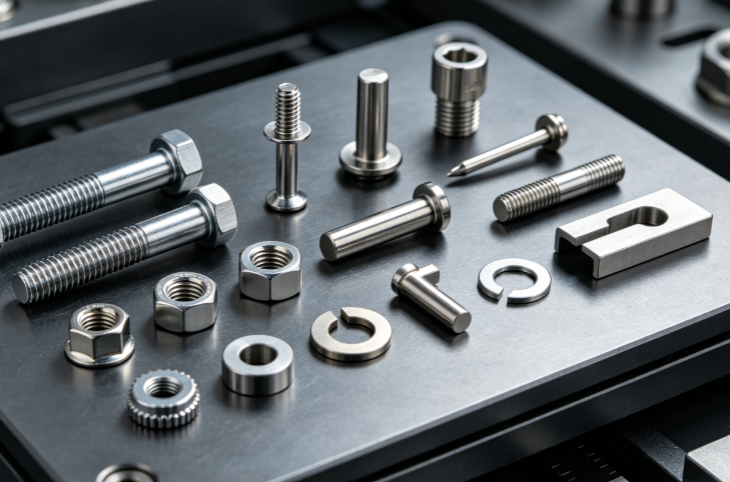
Table of Contents
1. Introduction
2. Main Fastener Product Range
3. Unique Performance Requirements Across Five High-end Manufacturing Sectors
4. Key Production Advantages for High-end Industrial Fastener Manufacturing
5. Common Risks When Using General-purpose Standard Fasteners
6. Data Comparison: Ordinary Standard Fasteners VS Application-engineered High-end Fasteners
7. Strict Whole-process Quality Control System
8. Detailed Application Analysis of Five Core High-end Manufacturing Sectors
9. Custom Fastener Development Service
10. Conclusion
11. Industry FAQ
1. Introduction
High-end manufacturing relies on stable, long-life mechanical connection solutions. Standard commodity fasteners often suffer inconsistent material quality, poor fatigue resistance, insufficient corrosion protection and limited dimensional precision, making them unsuitable for safety-critical and precision equipment.
Industrial fastener components covering bolts, rivets, rivet nuts, self-clinching hardware, pins and customized special-shaped fasteners serve five core high-end manufacturing sectors: new energy vehicles, aerospace, medical equipment, industrial automation & robotics, and rail transit equipment. Through targeted material selection, cold/hot forming, thread rolling, heat treatment and surface modification, these fasteners achieve balanced lightweight performance, vibration fatigue resistance, temperature stability and environmental durability. They deliver reliable joining for thin-plate multi-material assemblies, precision modules and long-cycle operating equipment.
This article analyzes differentiated technical requirements across each industry, fastener design principles and production control standards, providing reliable technical procurement reference for equipment OEMs, component manufacturers and engineering design institutes.
Core Industry Keywords: industrial fastener components, high-end manufacturing fasteners, new energy vehicle fasteners, aerospace fasteners, medical equipment fasteners, automation equipment fasteners, rail transit fasteners, custom rivets and rivet nuts, lightweight engineered fasteners, high-precision mechanical connection parts
2. Main Fastener Product Range
2.1 Threaded Fasteners
High-strength alloy steel bolts, stainless steel screws, self-locking nuts, anti-loosening washers, press-in studs, customized threaded inserts. Material grades: carbon steel, alloy steel, 304/316 stainless steel, aluminum alloy, titanium alloy.
2.2 Blind Joining Fasteners
Core pull blind rivets, structural rivets, rivet nuts (blind threaded inserts), self-piercing rivets (SPR). Suitable for single-sided assembly of closed cavities and thin sheet panels.
2.3 Precision Locating & Locking Components
Positioning pins, elastic retaining rings, special-shaped clips, customized clamping fasteners for limited-space precision modules.
2.4 Custom Special-shaped Fasteners
Non-standard offset head fasteners, insulated fasteners, ultra-thin low-profile connectors, lightweight hollow optimized fasteners developed according to customer engineering drawings.
2.5 Surface Treatment Options
Zinc plating, nickel plating, Dacromet / Geomet, passivation, anodizing, PTFE composite coating, medical-grade electropolishing, low-outgassing cleanroom surface finishing.
3. Unique Performance Requirements Across Five High-end Manufacturing Sectors
3.1 New Energy Vehicle Industry
· Lightweight demand: aluminum alloy fasteners reduce curb weight for battery platforms and body panels;
· Multi-material compatibility: control galvanic corrosion between aluminum, composite and steel substrates;
· Thermal cycling stability: resist repeated heating / cooling of battery systems to avoid loosening;
· Vibration fatigue: withstand continuous road vibration;
· Waterproof & anti-corrosion for chassis and battery compartment environments.
3.2 Aerospace Industry
· Extreme wide temperature range: stable performance from low-altitude ambient to high-altitude low-temperature operating conditions;
· High specific strength: titanium and high-strength alloy fasteners balance weight reduction and structural safety;
· Strict material traceability, low impurity control;
· Fatigue resistance under alternating flight load;
· Low-outgassing requirements for airborne electronic and optical assemblies.
3.3 Medical Equipment Industry
· Biocompatible and non-toxic material grades for surgical instruments and diagnostic hardware;
· Smooth, burr-free surface, easy cleaning and sterilization;
· Stable corrosion resistance under repeated disinfection cycles;
· High dimensional precision for precision motion modules;
· No volatile contaminants that may affect patient safety.
3.4 Industrial Automation & Robotics
· High precision for servo module and joint assembly;
· Anti-fatigue performance for continuous reciprocating motion;
· Cleanroom-grade low-dust surface options for electronic and semiconductor equipment;
· Consistent performance supporting high-speed automated assembly line installation.
3.5 Rail Transit Equipment
· Ultra-long vibration fatigue life for bogies and car body connections;
· Flame retardant and low-smoke requirements for passenger carriage components;
· Weather resistance: adapt to outdoor temperature variation, humidity and salt spray along operation routes;
· Stable preload retention under long-term cyclic load.
4. Key Production Advantages for High-end Industrial Fastener Manufacturing
4.1 Targeted Material Matching
Select alloy steel, stainless steel, aluminum or titanium alloy according to load, temperature and environmental conditions, avoiding over-specification or insufficient performance.
4.2 Precision Forming & Thread Processing
Multi-station cold forming, precision thread rolling, controlled heat treatment to optimize internal material fiber flow and improve fatigue resistance.
4.3 Application-specific Surface Engineering
Custom coating thickness and formulation to balance anti-corrosion, friction coefficient and avoiding interference with adjacent materials.
4.4 Strict Dimensional Consistency
Tight tolerance control ensures stable feeding on automated assembly equipment, eliminating jamming and assembly mismatch.
4.5 Full-cycle Custom Engineering Support
From drawing review, finite element joint simulation, prototype trial production to mass manufacturing; complete test reports and certification documentation for industry audit requirements.
5. Common Risks When Using General-purpose Standard Fasteners
5.1 One-size-fits-all material cannot match operating conditions
Ordinary carbon steel fasteners corrode or fatigue prematurely in high-vibration, high-humidity or wide-temperature environments.
5.2 Poor dimensional repeatability
Large tolerance fluctuation leads to automated assembly line jamming and inconsistent joint preload.
5.3 Uncontrolled surface treatment
Thin or uneven plating causes rusting; excessive surface friction leads to thread galling during assembly.
5.4 Lack of fatigue performance verification
General fasteners only undergo static tensile testing, without long-term vibration fatigue simulation.
5.5 Incomplete documentation
Cannot provide traceability reports, material certificates and ageing test data required for high-end equipment acceptance.
6. Data Comparison: Ordinary Standard Fasteners VS Application-engineered High-end Fasteners
The table below summarizes typical test data collected from high-end manufacturing component development projects.
表格
Inspection Item | Ordinary Commercial Standard Fasteners | High-end Application-engineered Fasteners | High-end Manufacturing Requirement |
Dimensional repeat tolerance | ±0.08 ~ ±0.15 mm | ≤±0.06 mm | Stable automated assembly |
Vibration fatigue cycle before failure | 80,000 ~ 150,000 cycles | ≥300,000 cycles (industry adjustable) | Long-service equipment reliability |
Salt spray resistance duration | 24–72 h | 120–500+ hours (custom coating) | Anti-corrosion for outdoor / humid environments |
Thread hardness uniformity | Wide fluctuation | Tightly controlled heat treatment | Prevent thread stripping and galling |
Material batch traceability | Limited records | Complete raw material and process archives | Support equipment lifecycle tracking |
Adaptability to multi-material assembly | Generic material options | Custom alloy & surface isolation design | Control galvanic corrosion risk |
Data clearly demonstrates that application-tailored high-end industrial fasteners effectively reduce hidden equipment failure risks and meet stringent safety and durability requirements across five core manufacturing sectors.
7. Strict Whole-process Quality Control System
7.1 Raw Material Incoming Inspection
Verify alloy composition, tensile strength, hardness and surface purity; reject batches with inconsistent mechanical properties.
7.2 Forming & Thread Rolling Process Monitoring
Track die wear; continuous sampling of outline dimension, thread profile and concentricity during mass production.
7.3 Heat Treatment Control
Precise temperature and holding time regulation to avoid over-tempering or excessive brittleness.
7.4 Surface Treatment Verification
Coating thickness, adhesion, salt spray and friction coefficient testing.
7.5 Mechanical Performance Batch Testing
Tensile test, shear test, fatigue simulation and torque retention testing.
7.6 Optical Sorting Final Audit
Screen for surface defects, dimensional deviation and burrs before packaging.
7.7 Complete Batch Traceability
Raw material batch, forming parameters and test records archived for full lifecycle tracking.
8. Detailed Application Analysis of Five Core High-end Manufacturing Sectors
8.1 New Energy Vehicle Industry
· Battery pack housing, module fixing brackets, cooling system connection fasteners;
· Aluminum alloy body, wheel arch, interior trim blind rivets and rivet nuts;
· Chassis auxiliary brackets, charging port and wiring harness fixing components.
8.2 Aerospace Industry
· Airframe structural connection bolts, lightweight titanium alloy fasteners;
· Equipment bay, sensor and optical assembly precision locking hardware;
· Cabin interior, landing gear auxiliary module fastening components.
8.3 Medical Equipment Industry
· Surgical instrument assembly pins and fastening screws;
· Diagnostic equipment, rehabilitation device housing precision fasteners;
· Sterilizable stainless steel fasteners for medical cabinets and test platforms.
8.4 Industrial Automation & Robotics
· Robot joint module high-precision bolts and locating pins;
· Automated equipment control cabinet, sensor fixed brackets;
· Semiconductor cleanroom equipment low-dust, low-outgassing fasteners.
8.5 Rail Transit Equipment
· EMU bogie, car body connection high-strength bolts;
· Passenger compartment interior assembly fasteners;
· Signal equipment, power distribution cabinet vibration-resistant fastening components.
9. Custom Fastener Development Service
We develop custom industrial fasteners according to engineering drawings, load conditions, operating temperature and assembly mode. Adjust material grade, geometry, thread specification and surface treatment scheme to balance performance and manufacturing cost. Support prototype small-batch trial production and scaled mass manufacturing. All batches can provide material certificates, mechanical test reports and supporting documentation for overseas project certification and tender requirements.
Engineering team conducts forming simulation and assembly trial verification to eliminate technical risks before formal mass production.
10. Conclusion
New energy vehicles, aerospace, medical equipment, automation robotics and rail transit represent five core high-end manufacturing sectors with strict safety and durability standards. Generic standard fasteners cannot satisfy differentiated operating conditions, creating hidden risks of loosening, fatigue fracture and corrosion.
Professional suppliers capable of developing application-engineered industrial fasteners implement targeted material selection, precision forming and customized surface treatment. Reliable mechanical connection performance supports lightweight design, precision assembly and long-term continuous operation of high-end equipment.
Component purchasers should prioritize fastener manufacturers with complete material testing, fatigue performance verification and full customization capabilities, rather than evaluating only unit price of standard commodity fasteners.
11. Industry FAQ
Q1: What is the difference between blind rivets / rivet nuts and ordinary threaded bolts? A: Blind rivets and rivet nuts enable single-sided assembly, ideal for closed cavity structures where rear-side access is unavailable; ordinary bolts require through-hole double-sided operation.
Q2: How to select fastener material for multi-material aluminum and steel assemblies? A: Match aluminum alloy fasteners to aluminum substrates; add isolating surface coating to reduce potential difference and suppress galvanic corrosion.
Q3: What surface treatment is recommended for new energy vehicle battery compartment fasteners? A: Dacromet, Geomet or high-performance nickel plating are commonly selected to achieve long salt spray resistance and avoid electrolyte corrosion.
Q4: Can medical fasteners meet sterilization cycle requirements? A: 316 stainless steel with electropolished surface can be customized to withstand repeated high-temperature sterilization.
Q5: What key testing items distinguish high-end fasteners from ordinary industrial fasteners? A: Vibration fatigue testing, accelerated ageing salt spray testing, thread galling test and long-term preload retention simulation are essential evaluation indicators for high-end manufacturing applications.